

By Haleema Khan and Amina Rahman
Following on from the great success of the Kenyan Project, a venture into another country to take the DiPS project international once again was simply a must.
The DiPS (Dentists in Primary Schools) project in Manchester has grown consistently since its conception in 2021. We have now reached a grand total of 1,763 children in 64 classes! Our feedback has been nothing but positive from our dedicated volunteers, school teachers and most importantly- students!
We have been asked to return and carry out our consultant-approved interactive sessions year after year and have had many enquiries from new schools as our reputation grows. The DiPS project was created primarily to address the alarmingly high rates of decay present in young children in Manchester; in September 2026, we travelled to Pakistan on the same premise.
While deciding where to travel to on our international venture, we came across Pakistan’s concerning oral disease burden figures. According to WHO (2019), in Pakistan:
- The prevalence of untreated caries of deciduous teeth in children 1-9 years is 45.7%
- The prevalence of untreated caries of permanent teeth in people 5+ years is 27.0%
Additionally, there are only 12 dentists per 100,000 people, compared to 52 per 100,000 in the UK, emphasising the significant gap between need and access to care. We specifically travelled to Tajak, a village in Attock, and other surrounding villages. Attock is the most northern province in Punjab and therefore has a diverse population speaking many different languages and different cultures in rural areas.
We also discovered that at 31%, Pakistan also has the highest if not one of the highest diabetes rates in the world. This meant that our oral health education not only emphasised oral hygiene regimes and diet, but also included an additional focus on sugar and the interaction between diabetes and periodontal disease.
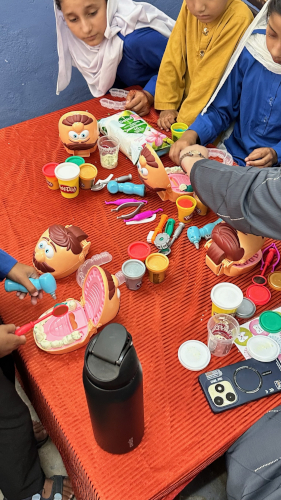
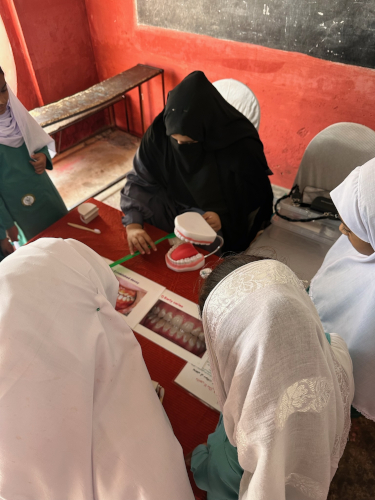
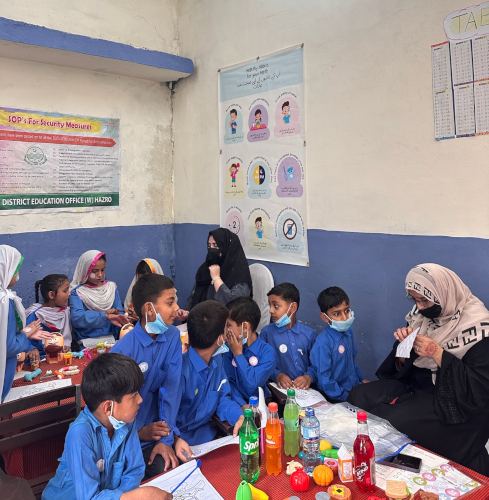
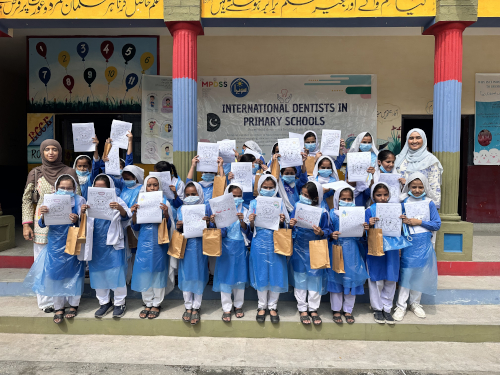
We equipped each child with a goodie bag containing essential tools such as a toothbrush, toothpaste and a translated leaflet detailing important oral health advice and knowledge. At the end of the 2 weeks, we had successfully reached over 1100 children! We visited 6 schools and delivered the traditional DiPS interactive sessions to students in Class 2, 3, and 4, (approximately aged 5-8) and presentations to Classes 5-10 (aged 8-16).
The success of this programme was largely due to our partnership with a local charity ‘The Sawera Foundation’, who provided us with committed volunteers, liaised with local schools and helped to culturally tailor our project for maximum impact. We were very impressed with their team when learning about their ongoing projects such as emergency ambulance services, clean water fund and widow and orphans support.
To ensure longevity of the project, it was imperative to us to select a local organisation that could continue this important work after we left. Prior to getting to Pakistan, we asked the Sawera Foundation to advertise and create a team of trusted volunteers that would help us carry out the sessions. Our first day in Tajak village consisted of an in-person volunteer training day, which the foundation kindly allowed us to carry out at the offices.
We began by setting up each of the stations and providing a clear overview of what each station involved, including the preferred approach to their delivery. We then covered all of the essential dental information required, allowing the team plenty of opportunity to ask questions and gain a thorough understanding of the day-to-day running of the sessions and presentations.
Conducting the training in person offered several additional benefits. It enabled us to establish strong working relationships ahead of the sessions, while also creating an opportunity for the team to connect and collaborate in a more relaxed setting. This was particularly evident while packing the goodie bags together. With approximately 900 bags to prepare initially, it could have been a lengthy task, but the time passed quickly thanks to the teamwork, shared conversations and plenty of laughter throughout the process.
An especially vital benefit of working with volunteers from the Sawera Foundation was bridging our more general level of spoken Urdu and Pashto (the two most common languages in the region) to a more sophisticated level required to discuss dental topics with the children. The volunteers, being native to the region, were fluent in both languages and able to navigate this slight ‘language barrier’ so we could ensure our presentations were understandable to all the children we visited. The words we used had to convey our message and still be easily understood by the children or our mission would be futile.
The following weekdays consisted of jam-packed days of visiting multiple different primary schools: 5am starts, many hours of driving and setting up our stations as quickly as possible to squeeze all the classes in. The sweltering 40 degree heat was the last of our concerns at this point!
We had the DiPS stations set up similar to the Manchester sessions, consisting of the following stations:
Toothbrushing Station: Tooth models were given to each child to practice tooth brushing and flossing techniques. A volunteer at this station would guide on correct techniques and ensure children were aware of the importance of reaching all tooth surfaces.
Sugar Station: This station involved using a range of toy foods, emphasis was placed on choosing healthier food options and steering away from unhealthy or sugary foods. A range of drinks were also available at this station to demonstrate how much sugar is present in juices and fizzy drinks. This station was adapted to include common drinks sold within Pakistan to make it more relevant to the children; a particularly popular energy drink, ‘Sting’, struck of interest as we discovered a 500ml bottle had 76g of sugar… and many children enjoyed this drink frequently!
- Tooth modelling Station: Children could use play-doh to create a set of teeth and instruments were provided to recreate giving ‘fillings’ or check the teeth with probes.
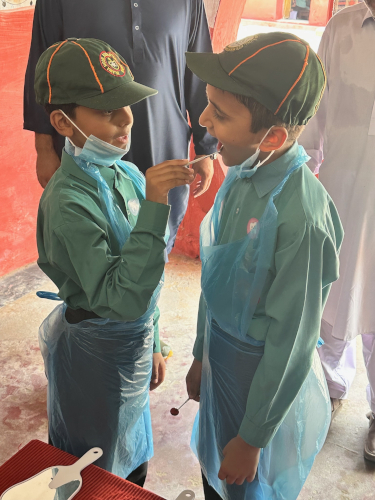
- Roleplay station: Children could roleplay an interaction between the ‘dentist’ and the ‘patient’ Barbies. This station was adapted to include aprons, masks and plastic mirrors so children could dress up as dentists and experience a ‘dental check-up’ on each other, bringing a more interactive element into the station. Using small dental mirrors also allowed children to become aware of their own teeth and hopefully more conscious of cleaning them. Success of this station has led to thoughts of bringing this activity to Manchester DiPS sessions too.
- Colouring Station: A quiet, relaxed station where children would colour cartoon images that are dental related. This station was utilised to include some questions to collect data from the children that would provide us with a better understanding of oral health habits in the region.
The questions asked at the colouring station were as follows:
- Do you brush your teeth every day? (Follow-up questions included: how many times a day and at what times of the day?)
- Have you been taught about toothbrushing and cleaning your teeth before?
- Do your family / people at home brush their teeth every day?
- Have you ever been to the dentist? (Follow up questions included: when did you go and why?)
By asking these questions, we not only gained a meaningful insight into the impact our project would have, but we were able to get the children to begin thinking about their brushing habits more. We noticed the children that did not raise their hands to answer ‘yes’ for the above questions increasingly realised there were ideal answers about oral hygiene habits, thus motivating the children’s future behaviour. This small social influence would also play a part in encouraging positive brushing habits, in an area where it is not as common or embedded within people’s daily routine as is within the UK.
Results of the above questions showed that many children did not brush every day and many had not even been taught about oral hygiene and the importance of brushing. For example, at one school just 26 out of 61 children answered yes to having been taught about oral hygiene before.
In order to overcome this barrier; the unfortunate lack of oral health education, we needed to ensure the longevity of our impact. Our mission aimed to also provide the community with resources to continue this essential education long after we returned to the UK, allowing us to achieve our aim of having a sustainable and long-lasting impact. We were able to do this by training up volunteers, allowing them to independently run sessions and presentations while we observed- a great way to build their confidence. We also created informative posters containing essential advice and highlighting the importance of brushing to anyone that passed through the school as well as added leaflets into every child’s goodie bag.
Throughout the course of the programme, we collected valuable feedback from classroom teachers, headteachers and our team of volunteers. Teachers were extremely happy with how the sessions ran, with many noting that this is the first project of its kind in the region.
A very pleased headteacher at the Government Boys’ High School we visited was delighted to say: “Many students in these rural schools had never been given this teaching and we believe they will follow your advice.” School teachers particularly complimented how interactive and engaging the sessions were and valued the creativity behind each station. Volunteers also gave us valuable feedback throughout the sessions, from ways to streamline the sessions to how to communicate with the students more effectively. The Sawera Foundation team’s primary feedback to us was the importance of returning to extend our reach to more schools within the region and perhaps create a tailored programme for older students.
A pleasant experience was the hospitality shown by staff and students alike at the schools; during breaks between DiPS sessions we were offered biscuits, chai and snacks to enjoy in the staff room. The courteous attitude reflected the staff and student’s eagerness to have visitors at their school and the student’s enthusiasm to learn.
Although we had many challenges to overcome before the programme got off the ground (i.e. funding issues, safety risks and limited support), and those that came up while we were there, we were able to overcome them all with our amazing support system that kept us going! We had power cuts, long travel times and no running water at times, but the satisfaction we got after completing this programme was worth it all.
We would like to extend our gratitude to SOMANDA, the BSPD (British Society of Paediatrics) and all our UK donors on our Crowdfunding page, without the financial support we would not have been able to materialise this project. Our warmest thanks to Haleon, particularly Seema Sispal, for donating materials for our goodie bags.
We also acknowledge and are deeply grateful for all the support from tutors, family and friends, that urged us to keep going and continuously supported us. Our deepest thanks to the University of Manchester, the Sawera Foundation and the schools, whom this would not have been possible without! Thank you for reading, and we look forward to what we achieve together in the future!